
Why is glass fiber added to PA66 material?
1. Increase strength and rigidity — Not easy to break or bend
Pure pa66:
Strength is average
Easily bends or becomes soft under stress
Screws strip or break easily when tightened
With glass fiber added:
Tensile, compressive, and bending resistance greatly improved
Screws can truly "lock," suitable for structural and load-bearing parts
2. Reduce molding shrinkage — More accurate dimensions, no shrinkage
Pure pa66:
High shrinkage
Dimensions unstable after injection molding
Threads easily deform, poor fit
With glass fiber added:
Shrinkage significantly reduced
Dimensions stable
High thread precision, screws easy to tighten, neither loose nor wobbly
3. Increase heat resistance — Doesn’t soften at high temperatures
Pure PA66:
Softens when heated
Strength drops quickly in high temperatures
With glass fiber added:
Heat distortion temperature significantly increased
Can be used in cars, appliances, and near heat sources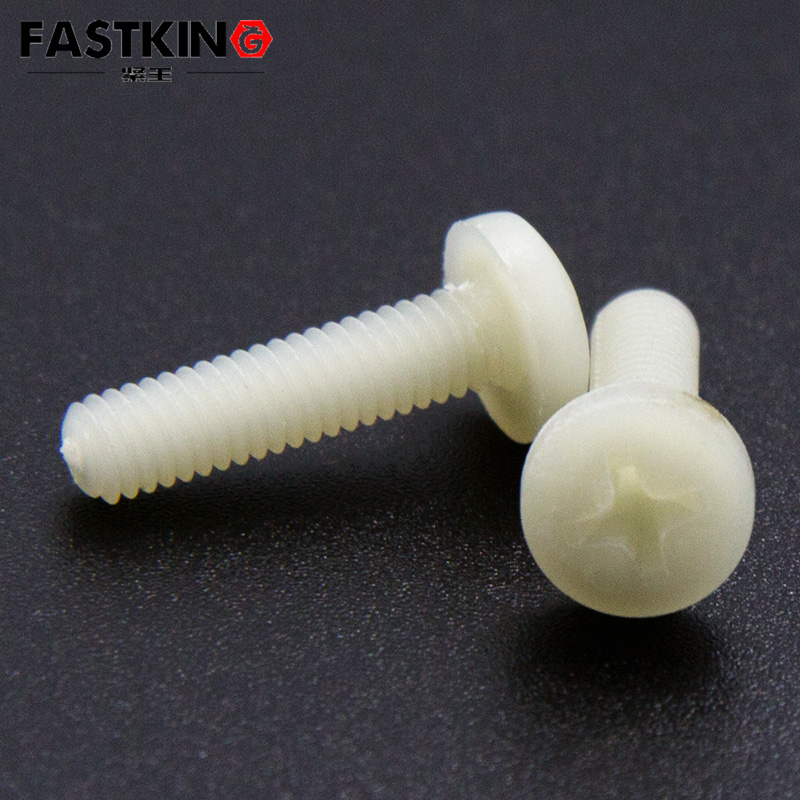
4. Reduce creep — Doesn’t slowly deform under long-term stress
Pure PA66:
Gradually elongates and deforms under long-term stress
Screws become looser over time
With glass fiber added:
Creep resistance increased
Screws remain stable and tight over long periods
5. Reduce water absorption — More stable dimensions
PA66 naturally absorbs water, after absorbing water:
Becomes soft
Dimensions increase
Strength decreases
Adding glass fiber reduces dimensional changes from water absorption, improving environmental stability
Significance for making nylon screws
Without glass fiber: PA66 cannot make qualified screws, too soft, prone to stripping and deformation.
With 30% glass fiber: Generally strongest, most stable, and cost-effective.
With 50% glass fiber: Even higher strength, heat resistance, and precision, but more brittle and harder to process.
Pure pa66:
Strength is average
Easily bends or becomes soft under stress
Screws strip or break easily when tightened
With glass fiber added:
Tensile, compressive, and bending resistance greatly improved
Screws can truly "lock," suitable for structural and load-bearing parts
2. Reduce molding shrinkage — More accurate dimensions, no shrinkage
Pure pa66:
High shrinkage
Dimensions unstable after injection molding
Threads easily deform, poor fit
With glass fiber added:
Shrinkage significantly reduced
Dimensions stable
High thread precision, screws easy to tighten, neither loose nor wobbly
3. Increase heat resistance — Doesn’t soften at high temperatures
Pure PA66:
Softens when heated
Strength drops quickly in high temperatures
With glass fiber added:
Heat distortion temperature significantly increased
Can be used in cars, appliances, and near heat sources
4. Reduce creep — Doesn’t slowly deform under long-term stress
Pure PA66:
Gradually elongates and deforms under long-term stress
Screws become looser over time
With glass fiber added:
Creep resistance increased
Screws remain stable and tight over long periods
5. Reduce water absorption — More stable dimensions
PA66 naturally absorbs water, after absorbing water:
Becomes soft
Dimensions increase
Strength decreases
Adding glass fiber reduces dimensional changes from water absorption, improving environmental stability
Significance for making nylon screws
Without glass fiber: PA66 cannot make qualified screws, too soft, prone to stripping and deformation.
With 30% glass fiber: Generally strongest, most stable, and cost-effective.
With 50% glass fiber: Even higher strength, heat resistance, and precision, but more brittle and harder to process.